Author Archives: Ayesha Haq

Unknown's avatar

About Ayesha Haq

A versatile chef ...

Old Fashioned Corn Pizza

This is a very retro style pizza. Now the pizzas are very innovative and customised but this was the 1st generation of pizzas, have alook and enjoy the lovely bits …

Ingredients:

  • 1 thin crust pizza base / Dough maker’s* Pizza base
  • 4 tbspns pizza sauce
  • ½ tspn garlic paste
  • 2 tbspns olive oil
  • ½ cup shredded mozzarella cheese
  • ½ cup shredded cheddar cheese
  • 2 button mushrooms chopped
  • 4 tbspns corn
  • A pinch of dried rosemary*
  • 1 pinch of dried oregano*

Procedure:

-Prepare a pizza base and apply some olive oil, garlic paste and pizza sauce. Now sprinkle some cheddar cheese and then some mozzarella cheese.

-Place some chopped muhrooms and Fresh maize or corn and top it withsome herbs, like oregano and rosemary.

-Bake in a preheated oven For 20 minutes on 190 degrees Celsius.

-When it is golden red, take it out and serve hot.

Outcome:

Tasty old Fashioned mushroom and corn pizza is ready to be served.

Ayesha's Kitchen

Ayesha's Kitchen

Tips:

-Serve it in retro style, in some old Fashioned crockery and cutlery and some old Fashioned presentation styles.

-Thickness of dough totally depends on your desire, i prefer thin crust and it is ready in 20 minutes, if you are making thick crust of puffy crust or stuffed crust then refer to “Tips” page.

Servings:

This will serve 2 persons easily.


*Refer to Glossary

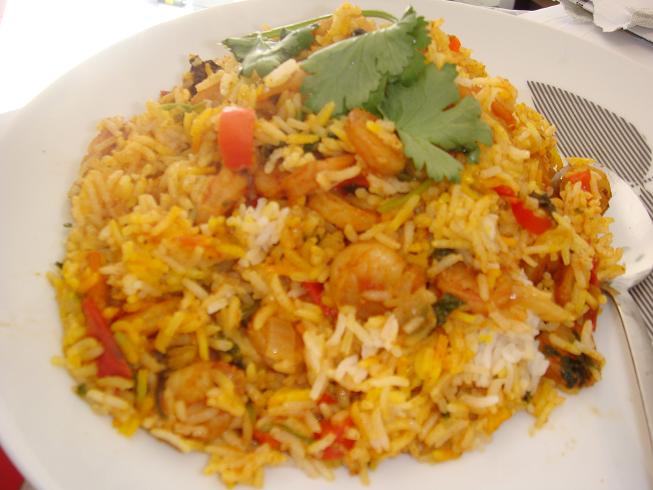
Prawn Biryani

Prawn Biryani (Jheenga Biryani) is ultimate don’t you think so???

Ingredients:

  • 1 kg prawns peeled and cooked*
  • 2 cups rice
  • 2 cardamom pods
  • 2 big cardamoms
  • 1 inch cinnamon stick
  • ½ onions chopped
  • 1 tomato chopped
  • 1 red chilli chopped
  • Some salt
  • Some red chilli powder (OPTIONAL)
  • ¼ tspn turmeric powder
  • ½ tspn coriander powder
  • ½ tspn cumin powder
  • A pinch of cumin seeds
  • 1 curry leaf
  • 2 black peppercorns
  • 2 tbspns Fresh coriander chopped
  • Few drops of yellow Food colour
  • ½ cup water

Procedure:

-Soak rice in water.

-Heat oil and add cardamom stuff, cinnamon, cumin seeds and curry leaf. When they begin to splatter add onion along with some salt and Fry until they lose their stiffness. Now add prawns and stir Fry them.

-Let them cook in their own water. When this mixture begins to dry add chopped tomato and other spices and herbs and mix. Add water whenever required.

-When prawns are nicely cooked remove From heat.

-Boil nearly a litre or 2 of water. Add soaked rice and when they are 90 % cooked drain them.

-In a thick bottomed pan,take half of the boiled rice a make layer then place a layer of cooked prawns and then again a layer of rice. At the end add very Few drops of yellow Food colour and cover the pan.

-Cook it For 5 – 10 minutes on very low heat. Make sure they do not stick to the bottom of utensil.

-Now dish them and serve hot with a sprig of Fresh green coriander.

Outcome:

Tasty and lovely, odourless prawn Biryani or Jheenga* Biryani is ready to be served.

Ayesha's Kitchen

Ayesha’s Kitchen

Tips:

-See “Tips” page For Rice Tips.

-Make sure your prawns are nicely cooked.

-You can adjust seasoning according to your taste.

-Peeled and cooked prawns are of pink colour and they are easily available Frozen in market.

Servings:

This will serve 4 persons easily.

*Refer to “Glossary” Page

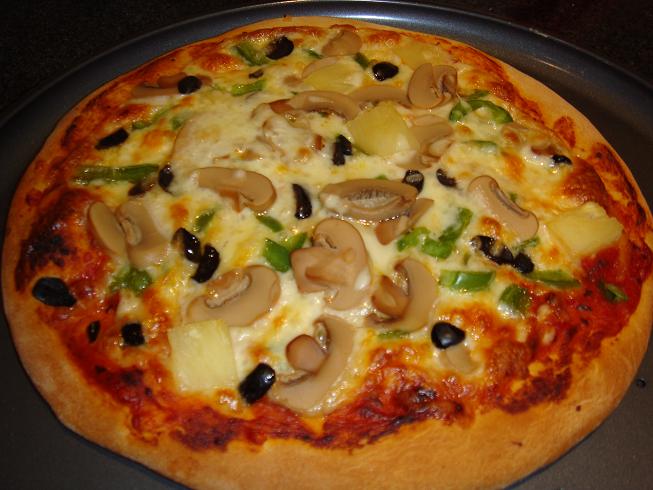
Kiwi Vegetarian Delight

Kiwis (the people of New Zealand) mostly enjoys the sweet and savoury taste together so they top up their pizzas with some pineapple to make it sweet with any other savoury topping, like they have ham with pineapple in Hawain Pizza, pineapple with pepperoni in Tony’s Pepperoni, etc. So here is the vegetarian delight pizza with all mushrooms, olives, capsicums and lovely tropical Fresh PINEAPPLE … Kiwis You people Rock …

Ingredients:

  • 1 thin crust pizza base/ Instant pizza base
  • ½ cup sliced pineapple
  • ¼ cup grated cheddar cheese
  • ½ cup mozzarella cheese
  • 4 champignons* sliced
  • 4 olives sliced
  • 4 tbspns pizza sauce
  • 2 tbspns olive oil
  • Some garlic paste

Procedure:

-Prepare pizza dough according to the recipe.

-Apply olive oil, some garlic and pizza sauce and then sprinkle both of the cheese.

-Now place the toppings as desired and bake in a preheated oven (200 degrees Celsius) For 20 minutes or until golden brown.

-Slice and serve.

Outcome:

Tasty kiwi style sweet pineapple pizza is ready to be served.

Ayesha's Kitchen

Ayesha's Kitchen

Tips:

-Preheat oven to 200 degrees Celsius 20 minutes – 30 minutes before baking.

-See “Tips” page For pizza and stuff.

Servings:

This will serve 4 persons easily.


*See glossary page.

Vegetable Of The Week

Ayesha's Kitchen

Ayesha's Kitchen

Apium graveolens is a plant species in the family Apiaceae commonly known as celery (var. dulce) or celeriac (var. rapaceum) depending on whether the petioles (stalks) or roots are eaten.

Uses

Apium graveolens is used around the world as a vegetable, either for the crisp petiole (leaf stalk) or the fleshy taproot.

In temperate countries, celery is also grown for its seeds. Actually very small fruit, these “seeds” yield a valuable volatile oil used in the perfume and pharmaceutical industries. They also contain an organic compound called apiol. Celery seeds can be used as flavouring or spice, either as whole seeds or ground and mixed with salt, as celery salt. Celery salt can also be made from an extract of the roots. Celery salt is used as a seasoning, in cocktails (notably to enhance the flavour of Bloody Mary cocktails), on the Chicago-style hot dog, and in Old Bay Seasoning.

Celery, onions, and bell peppers are the holy trinity of Louisiana Creole and Cajun cuisine. Celery, onions, and carrots make up the French mirepoix, often used as a base for sauces and soups. Celery is a staple in many soups, such as chicken noodle soup. Celery is an important ingredient in Indian cuisines including in Indian Curry.

Celery is widely eaten by guinea pigs, dogs, horses, birds, squirrels, and small rodents.

Nutrition

Celery is valuable in weight-loss diets, where it provides low-calorie dietary fiber bulk. Celery contains androstenone. Bergapten in the seeds can increase photosensitivity, so the use of essential oil externally in bright sunshine should be avoided. The oil and large doses of seeds should be avoided during pregnancy: they can act as a uterine stimulant. Seeds intended for cultivation are not suitable for eating as they are often treated with fungicides. There is a common belief that celery is so difficult for humans to digest, that it has negative calories because human digestion burns more calories than can be extracted. Celery seeds are also a great source of calcium, and are regarded as a good alternative to animal products.

Allergies

Celery is amongst a small group of foods (headed by peanuts) that appear to provoke the most severe allergic reactions; for people with celery allergy, exposure can cause potentially fatal anaphylactic shock. The allergen does not appear to be destroyed at cooking temperatures. Celery root—commonly eaten as celeriac, or put into drinks—is known to contain more allergen than the stalk. Seeds contain the highest levels of allergen content. Exercise-induced anaphylaxis may be exacerbated. An allergic reaction also may be triggered by eating foods that have been processed with machines that have previously processed celery, making avoiding such foods difficult. In contrast with peanut allergy being most prevalent in the US, celery allergy is most prevalent in Central Europe. In the European Union, foods that contain or may contain celery, even in trace amounts, have to be clearly marked as such.

Recipes:

Well till now I haven’t used celery too much in my dishes, but will update soon.

Fruit Of The Week POMEGRANATE

Ayesha's Kitchen

Ayesha's Kitchen

The pomegranate (Punica granatum) is a fruit-bearing deciduous shrub or small tree growing to between five and eight meters tall. The pomegranate is native to Southwest Asia and has been cultivated in the Caucasus since ancient times. It is widely cultivated throughout Afghanistan, Algeria, Armenia, Azerbaijan, Iran, Iraq, India, Israel, Pakistan, Syria, Turkey, the drier parts of southeast Asia, Peninsular Malaysia, the East Indies, and tropical Africa. Introduced into Latin America and California by Spanish settlers in 1769, pomegranate is now cultivated in parts of California and Arizona for juice production.

In the Northern Hemisphere, the fruit is typically in season from September to February. In the Southern Hemisphere, it is in season from March to May.

About 760 different local varieties of pomogranate have been reconized in Iran. These varieties have been collected in Agricultural Research Institute, Yazd, Iran. The most famous varieties are Soveh, Sioh, Rabob, Aghaei, Ardestony, Shisheh cap, Shirin Shahvor, Bajestony, Malas e Daneh Siah, Touq Gardan, Khazar, Shecar e Ashraf (Behshahr), Alak, Arous, Farouq, Rahab, Khafar e Shiraz, Ferdous e Khorasan, Bi daneh Sangan.

Etymology

The name “pomegranate” derives from Latin pomum (“apple”) and granatus (“seeded”). This has influenced the common name for pomegranate in many languages (e.g., German Granatapfel, seeded apple). In early English, the Pomegranate was known as “apple of Grenada” — a term which today survives only in heraldic blazons. This was probably a folk etymology, confusing Latin granatus with the Spanish city of Granada. The genus name Punica is named for the Phoenicians, who were active in broadening its cultivation, partly for religious reasons. In classical Latin, where “malum” was broadly applied to many apple-like fruits, the pomegranate’s name was malum punicum or malum granatum, the latter giving rise to the Italian name melograno, or less commonly melagrana.

A widespread root for “pomegranate” comes from the Ancient Egyptian rmn, from which derive the Hebrew rimmôn, and Arabic rummân. This root was given by Arabs to other languages, including Portuguese (romã), Kabyle rrumman and Maltese “rummien”. The pomegranate (‘rimmôn’) is mentioned in the Bible as one of the seven fruits/plants that Israel was blessed with, and in Hebrew, ‘rimmôn’ is also the name of the weapon now called the grenade. According to Webster’s New Spanish-English Dictionary, “granada,” the Spanish word for “pomegranate,” could also mean “grenade.” According to the OED, the word “grenade” originated about 1532 from the French name for the pomegranate, la grenade. La grenade also gives us the word grenadine, the name of a kind of fruit syrup, originally made from pomegranates, which is widely used as a cordial and in cocktails.

Culinary Uses

After opening the pomegranate by scoring it with a knife and breaking it open, the arils (seed casings) are separated from the peel and internal white pulp membranes. Separating the red arils is simplified by performing this task in a bowl of water, wherein arils sink and pulp floats. It is also possible to freeze the whole fruit in the freezer, making the red arils easy to separate from the white pulp membranes. The entire seed is consumed raw, though the watery, tasty aril is the desired part. The taste differs depending on subspecies of pomegranate and its ripeness. The pomegranate juice can be very sweet or sour, but most fruits are moderate in taste, with sour notes from the acidic tannins contained in the aril juice.

Having begun wide distribution in the United States and Canada in 2002, pomegranate juice has long been a popular drink in Middle Eastern and Indian cuisine, India.

Grenadine syrup is thickened and sweetened pomegranate juice used in cocktail mixing. Before tomato arrived in the Middle East, grenadine was widely used in many Iranian foods and is still found in traditional recipes such as fesenjan, a thick sauce made from pomegranate juice and ground walnuts, usually spooned over duck or other poultry and rice, and in ash-e anar (pomegranate soup).

Wild pomegranate seeds are sometimes used as a spice known as anardana (which literally means pomegranate (anar) seeds (dana) in Persian), most notably in Indian and Pakistani cuisine but also as a replacement for pomegranate syrup in Middle Eastern cuisine. As a result of this, the dried whole seeds can often be obtained in ethnic Indian Sub-continent markets. The seeds are separated from the flesh, dried for 10–15 days and used as an acidic agent for chutney and curry production. Seeds may also be ground in order to avoid becoming stuck in teeth when eating dishes containing them. Seeds of the wild pomegranate daru from the Himalayas are regarded as quality sources for this spice.

Making pomegranate juice at a stall in TurkeyIn the Caucasus, pomegranate is used mainly as juice. In Azerbaijan a sauce from pomegranate juice (narsharab) is usually served with fish or tika kabab. In Turkey, pomegranate sauce, (Turkish: nar ekşisi) is used as a salad dressing, to marinate meat, or simply to drink straight. Pomegranate seeds are also used in salads and sometimes as garnish for desserts such as güllaç. Pomegranate syrup or molasses is used in muhammara, a roasted red pepper, walnut, and garlic spread popular in Syria and Turkey. Pomegranate wine is produced in Israel and Armenia.

In Greece, pomegranate (Greek: ρόδι, rodi) is used in many recipes, including kollivozoumi, a creamy broth made from boiled wheat, pomegranates and raisins, legume salad with wheat and pomegranate, traditional Middle Eastern lamb kebabs with pomegranate glaze, pomegranate eggplant relish, and avocado-pomegranate dip. Pomegranate is also made into a liqueur and popular fruit confectionery used as ice cream topping or mixed with yogurt or spread as jam on toast. In Cyprus as well as in Greece and among the Greek Orthodox Diaspora , ρόδι is used to make kolliva, a mixture of wheat, pomegranate seeds, sugar, almonds and other seeds served at memorial services.

Recipes:

Whenever pomegranate will be in season in western Australia I will definitely upload lots of recipes.
Home Made Biryani Masala

Avoid using commercial spices because they contain artificial colours and preservatives which are sometime injurious to health, they can be a cause food poisoning and direa. So try to make these special masalas at your place …

FOR 1 kg meat and 2 cups of rice

Ingredients:

POWDER

  • Salt to taste
  • 2 tbspns red chilli powder
  • 1 tbspn ginger powder
  • 1 tbspn garlic powder
  • A handful of fried dehydrated onions
  • 2 tbspns of cumin seeds
  • 4 dried curry leaves
  • 1 tbspn nigella seeds (kalonji)
  • ½ tbspn turmeric powder
  • 2 tbspn whole dry coriander
  • 4 green cardamom pods
  • 2 black cardamoms
  • 1 tspn methi dana
  • 1 piece of cinnamon 4cm
  • 6 – 8 cloves
  • 1/2 tspn amchur powder

WHOLE GARAM MASALA

  • A piece of cinnamon stick
  • 2 cardamoms green
  • 1 star spice
  • 4 black cardamom
  • 2 dried red chillies
  • 4 cloves
  • 4 black peppercorns
  • 2 curry leaves
  • 1 bay leaf

FOOD FLAVOURS

  • 4 tbspns Lemon juice
  • Few drops of Kewra essence
  • Few drops of aniseed essence

Procedure:

-Combine all the ingredients give for powder in a spice blender and blend into powder.

-Now combine this powder and whole garam masala and use.

Chef’s Advice:

I will advise you to keep powdered masala and whole masala separately, because whenever I cook Biryani, I add whole masala first into oil to infuse all the flavours and then powdered masala when cooking my tomatoes.

Lemon juice can be used as citric acid, obviously you don’t have chemistry lab at home. And kewra is the special kind of essence that is used to give a unique Biryani flavour. So don’t forget it.

In all my Biryani recipes, I have written Whole garam masala, if you are using this recipe of biryani masala then avoid that one.

This is a very simple biryani masala, you can adjust the hotness by adding red chilli flakes or red chilli powder.

This recipe is for basic biryani, more biryani masala recipes are now there.