Yearly Archives: 2009

Fruit Of The Week GUAVA

Guava

Guavas are plants in the myrtle family (Myrtaceae) genus Psidium, which contains about 100 species of tropical shrubs and small trees. Native to Mexico and Central America, northern South America. Most likely naturally spreading (by means of ocean drifting) to parts of the Caribbean and some parts of North Africa, guavas are now cultivated and naturalized throughout the tropics, and due to growing demand they are also grown in some subtropical regions.

Facts On The Fruit

The most frequently-encountered species, and the one often simply referred to as “the guava”, is the Apple Guava (Psidium guajava).

Guavas are typical Myrtoideae, with tough dark leaves that are opposite, simple, elliptic to ovate and 5-15 cm long. The flowers are white, with five petals and numerous stamens.

The genera Accara and Feijoa (= Acca, Pineapple Guava) were formerly included in Psidium.

Common Names

The term “guava” appears to derive from Arawak guayabo “guava tree”, via the Spanish guayaba. It has been adapted in many European languages: guava (Swedish, Danish and Norwegian, also Greek Γκουάβα and Russian Гуава), Guave (Dutch and German), goyave (French), gujawa (Polish), goiaba (Portuguese).

Outside of Europe, the Arabic jwafa,the Punjabi “amrud”, the Japanese guaba (グアバ), the Tamil goiyaa, the Tongan kuava and probably also the Tagalog bayabas are ultimately derived from the Arawak term.

Another term for guavas is pera or variants thereof. It is common around the western Indian Ocean and probably derives from Portuguese, which means “pear”, or from some language of southern India, though it is so widespread in the region that its origin cannot be clearly discerned anymore. Pera itself is used in Malayalam, Sinhala and Swahili. In Marathi it is peru, in Bengali pearah, and in Dhivehi feyru.

In northern India and Southeast Asia, there are some other names for guavas which have a more limited use. These include jaam (used in Farsi, Hindi, Punjabi and Urdu). Jaama is used in Telugu, jaamba (in addition to peru) in Marathi, jambu or jambu batu in Indonesian and Malay, and jhamruk or jaamfal in Gujarati. Note that jambu or jumbu may also refer to Syzygium fruit (rose apples or water apples).

The more widespread name for guavas in Northern India is amrood (used in Farsi, Hindi, Punjabi and Urdu as an alternative to jaam), bihi (used in some Central Indian dialects of Hindi), da-bike (Khmer), ổi (Vietnamese, pa̍t-á (Min Nan), peguulli (Oriya), pha-rang (Thai) and seebe kayi (Kannada). In Assam (India), it is known as “Modhuri Aam” in Assamese & the fruit is very popular.

Additional terms for guavas from their native range are, for example, sawintu (Quechua) and xālxocotl (Nāhuatl)

Ecology And Uses

Psidium species are used as food plants by the caterpillars of some Lepidoptera, mainly moths like the Ello Sphinx (Erinnyis ello), Eupseudosoma aberrans, Snowy Eupseudosoma (E. involutum) and Hypercompe icasia. Mites like Pronematus pruni and Tydeus munsteri are known to parasitize the Apple Guava (P. guabaya) and perhaps other species. The bacterium Erwinia psidii causes rot diseases of the Apple Guava.

The fruit are not only relished by humans, but by many mammals and birds as well. The spread of introduced guavas owes much to this fact, as animals will eat the fruit and disperse the seeds in their droppings.

In several tropical regions, including Hawaii, some species (namely Strawberry guava, P. littorale) have become invasive species. On the other hand, several species have become very rare due to habitat destruction and at least one (Jamaican Guava, P. dumetorum), is already extinct.

Guava wood is used for meat smoking in Hawaiʻi and is being used at barbecue competitions across the United States. In Cuba the leaves are also used in barbecues, providing a nice smoked flavor and scent to the meat.

Cultivation For Fruit

Guavas are cultivated in many tropical and subtropical countries for their edible fruit. Several species are grown commercially; Apple Guava (P. guajava) and its cultivars are those most commonly traded internationally.

Mature trees of most species are fairly cold-hardy and can survive as low as 5 °C (41 °F) for short periods of time, but younger plants will not survive. They are known to survive in Northern Pakistan where they can get down to 5°C or lower during the night. Guavas are also of interest to home growers in temperate areas, being one of the very few tropical fruits that can be grown to fruiting size in pots indoors.

Culinary Uses

Guava fruit, usually 4 to 12 cm long, are round or oval depending on the species. The outer skin may be rough, often with a bitter taste, or soft and sweet. Varying between species, the skin can be any thickness, is usually green before maturity, but becomes yellow, maroon, or green when ripe. Guava fruit generally have a pronounced and typical fragrance, similar to lemon rind but less sharp. Guava pulp may be sweet or sour, off-white to deep pink, with the seeds in the central pulp of variable number and hardness, again depending on species.

Guavas in Larkana, PakistanThe fruit is also often prepared as a dessert. In Asia, fresh raw guava is often dipped in preserved prune powder or salt. Because of the skin’s high level of pectin, boiled guava is also extensively used to make candies, preserves, jellies, jams, marmalades (goiabada), and also for juices and aguas frescas. Guava juice is very popular in Mexico, Colombia, Egypt and South Africa. Red guavas can be used as the base of salted products such as sauces, constituting a substitute for tomatoes, especially for those sensitive to the latter’s acidity. In Asia, a tea is made from guava fruits and leaves.

Nutritional Value

Guavas are often marketed as “superfruits”, being rich in vitamins A and C, and if the seeds are eaten too, omega-3 and omega-6 polyunsaturated fatty acids and especially high levels of dietary fiber. A single Apple Guava (P. guajava) fruit contains over four times the amount of vitamin C as a single orange (over 200 mg per 100 g serving) and also has good levels of the dietary minerals, potassium, magnesium, and generally a broad, low-calorie profile of essential nutrients.

However, nutritional value is greatly dependent on species, the Strawberry Guava (P. littorale var. cattleianum) notably containing only 30–40 mg of vitamin C per 100g serving, practically a tenth of the vitamin C found in more common varieties. Vitamin C content in the Strawberry Guava is still a high percentage (62%) of the Dietary Reference Intake however.

‘Thai Maroon’ guavas, a red Apple Guava cultivar extremely rich in antioxidants

Green apple guavas are less rich in antioxidantsGuavas contain both carotenoids and polyphenols – the major classes of antioxidant pigments –, giving them relatively high dietary antioxidant value among plant foods. As these pigments produce the fruits’ color, guavas that are red or orange in color have more potential value as antioxidants sources than yelllowish-green ones.

Medical Uses

Since the 1950s, guavas – particularly the leaves – have been a subject for diverse research in chemical identity of their constituents, pharmacological properties and history in folk medicine; most research has been restricted to the Apple Guava (P. guajava) however, and any additional beneficial properties of other species remain essentially unstudied. From preliminary medical research in laboratory models, extracts from Apple Guava leaves or bark are implicated in therapeutic mechanisms against cancer, bacterial infections, inflammation and pain. Essential oils from guava leaves have shown strong anti-cancer activity in vitro.

Guava leaves are used in folk medicine as a remedy for diarrhea and, as well as the bark, for their supposed antimicrobial properties and as an astringent. Guava leaves or bark are used in traditional treatments against diabetes.

Recipes

You can Find number of different recipes in Ayesha’s Kitchen.
Vegetable Of The Week BITTER MELON

Bitter Mellon

Momordica charantia is a tropical and subtropical vine of the family Cucurbitaceae, widely grown for edible fruit, which is among the most bitter of all vegetables. English names for the plant and its fruit include bitter melon or bitter gourd (translated from Chinese: 苦瓜; pinyin: kǔguā), and karela from the Indian name of the vegetable.

The original home of the species is not known, other than that it is a native of the tropics. It is widely grown in South and Southeast Asia, China, Africa, and the Caribbean.

Description

The herbaceous, tendril-bearing vine grows to 5 m. It bears simple, alternate leaves 4-12 cm across, with 3-7 deeply separated lobes. Each plant bears separate yellow male and female flowers.

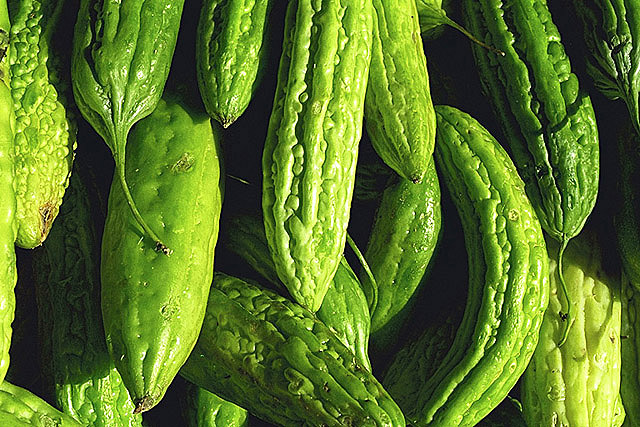
The fruit has a distinct warty looking exterior and an oblong shape. It is hollow in cross-section, with a relatively thin layer of flesh surrounding a central seed cavity filled with large flat seeds and pith. Seeds and pith appear white in unripe fruits, ripening to red; they are not intensely bitter and can be removed before cooking. However, the pith will become sweet when the fruit is fully ripe, and the pith’s color will turn red. The pith can be eaten uncooked in this state, but the flesh of the melon will be far too tough to be eaten anymore. Red and sweet bitter melon pith is a popular ingredient in some special southeast Asian style salad. The flesh is crunchy and watery in texture, similar to cucumber, chayote or green bell pepper. The skin is tender and edible. The fruit is most often eaten green. Although it can also be eaten when it has started to ripen and turn yellowish, it becomes more bitter as it ripens. The fully ripe fruit turns orange and mushy, is too bitter to eat, and splits into segments which curl back dramatically to expose seeds covered in bright red pulp.

Bitter melon comes in a variety of shapes and sizes. The typical Chinese phenotype is 20 to 30 cm long, oblong with bluntly tapering ends and pale green in color, with a gently undulating, warty surface. The bitter melon more typical of India has a narrower shape with pointed ends, and a surface covered with jagged, triangular “teeth” and ridges. Coloration is green or white. Between these two extremes are any number of intermediate forms. Some bear miniature fruit of only 6 – 10 cm in length, which may be served individually as stuffed vegetables. These miniature fruit are popular in Southeast Asia as well as India.

Culinary Uses

Bitter melons are seldom mixed with other vegetables due to the strong bitter taste, although this can be moderated to some extent by salting and then washing the cut melon before use.

Bitter melon is often used in Chinese cooking for its bitter flavor, typically in stir-fries (often with pork and douchi), soups, and also as tea.

It is also a popular vegetable in the cuisines of South Asia and the West Indies. In these culinary traditions, it is often prepared with potatoes and served with yogurt on the side to offset the bitterness, or used in sabji. Bitter melon is stuffed with spices and then fried in oil, which is very popular in Punjabi Cuisine. It is a popular food in Tamil Nadu and referred as பாகற்காய் (Pagarkai) slangily called as Pavakkai பாவக்காய். Bitter Gourd is popular in the cuisine of South Indian state of Kerala. They use it for making a dish called thoran mixed with grated coconut, theeyal and pachadi. This is one common medicinal food for diabetics. In Karnataka, the term used for bitter gourd is haagalakai (ಹಾಗಲಕಾಯಿ) and used in preparation of a delicacy called gojju (ಗೊಜ್ಜು). In Andhra Pradesh, it is called as ” Kaakarakaaya ” (కాకరకాయ). Popular recipes are curry, deep fry with peanuts (ground nuts) , ‘Pachi Pulusu’ (కాకరకాయ పచ్చి పులుసు), a kind of soup made up of boiled Bitter Melon, fried onions and other spices.

Bitter melon is rarely used in mainland Japan, but is a significant component of Okinawan cuisine, it is credited with Okinawan life expectancies being significantly higher than already long Japanese ones. Bitter melon oil contains Eleostearic acid, which is shown to prevent angiogenesis, which is implicated in the growth (but not the incidence) of cancer.

In Indonesia, bitter melon is prepared in various dishes, such as stir fry, cooked in coconut milk, or steamed.

In Vietnam, raw bitter melon slices consumed with dried meat floss and stuffed to make bitter melon soup with shrimp are popular dishes. Bitter melons stuffed with ground pork are served as a popular summer soup in the South.

It is prepared in various dishes in the Philippines, where it is known as Ampalaya. Ampalaya may also be stir-fried with ground beef and oyster sauce, or with eggs and diced tomato.

A very popular dish from the Ilocos region of the Philippines, pinakbet, consists mainly of bitter melons, eggplant, okra, string beans, tomatoes, lima beans, and other various regional vegetables stewed with a little bagoong-based stock.

The young shoots and leaves may also be eaten as greens; in the Philippines, where bitter melon leaves are commonly consumed, they are called dahon (leaves) ng ampalaya.

The seeds can also be eaten, and have a sweet taste; but are known to cause nausea In Nepal bitter melon is prepared in various ways. Most prepare it as fresh achar (a type of pickle). For this the bitter gourd is cut into cubes or slices and sautéed covered in little oil and a sprinkle of water. When it is softened and reduced, it is minced in a mortar with few cloves of garlic, salt and a red or green pepper. Another way is the sautéed version. In this, bitter gourd is cut in thin round slices or cubes and fried (sauteed) with much less oil and some salt, cumin and red chili. It is fried until the vegetable softens with hints of golden brown. It is even prepared as a curry on its own, or with potato; and made as stuffed vegetables.

In Pakistan bitter melon is available in the summertime, and is cooked with lots of onions.

A Malaysian-style bitter melon dish, cooked with sambal, onion, and red bird’s-eye chili peppersA traditional way to cook bitter melon curry is to peel off the skin and cut into thin slices. It is salted and exposed to direct sunlight for few hours to reduce its bitterness. After a few hours, its salty, bitter water is reduced by squeezing out the excess by hand. Then it’s rinsed with water a few times. Then fried in cooking oil, with onions also fried in another pan. When the onions have turned a little pink in color, the fried bitter melon is added to them. After some further frying of both the onions and bitter melon, red chili powder, turmeric powder, salt, coriander powder, and a pinch of cumin seeds are also added. A little water can be sprinkled while frying the spices to prevent burning. Then a good amount of tomato is added to the curry, with green chillies, according to taste. Now the pan is covered with a lid, heat reduced to minimum, the tomatoes reduce, and all the spices work their magic. The curry is stirred a few times (at intervals) during this covering period. After half an hour or so, the curry is ready to serve, with soft hot flatbreads (chappatis, چپاتی) and yogurt chutney.

Another dish in Pakistan calls for whole, unpeeled bitter melon to be boiled and then stuffed with cooked ground beef. In this dish, it is recommended that the bitter melon be left ‘debittered’. It is either served with hot tandoori bread, naan, chappati, or with khichri (a mixture of lentils and rice).

Medicinal Uses

Bitter melon has been used in various Asian traditional medicine systems for a long time [1]. Like most bitter-tasting foods, bitter melon stimulates digestion. While this can be helpful in people with sluggish digestion, dyspepsia, and constipation, it can sometimes make heartburn and ulcers worse. The fact that bitter melon is also a demulcent and at least mild inflammation modulator, however, means that it rarely does have these negative effects, based on clinical experience and traditional reports.

Though it has been claimed that bitter melon’s bitterness comes from quinine, no evidence could be located supporting this claim. Bitter melon is traditionally regarded by Asians, as well as Panamanians and Colombians, as useful for preventing and treating malaria. Laboratory studies have confirmed that various species of bitter melon have anti-malarial activity, though human studies have not yet been published.

In Panama bitter melon is known as Balsamino. The pods are smaller and bright orange when ripe with very sweet red seeds, but only the leaves of the plant are brewed in hot water to create a tea to treat malaria and diabetes. The leaves are allowed to steep in hot water before being strained thoroughly so that only the remaining liquid is used for the tea.

Laboratory tests suggest that compounds in bitter melon might be effective for treating HIV infection. As most compounds isolated from bitter melon that impact HIV have either been proteins or glycoproteins lectins), neither of which are well-absorbed, it is unlikely that oral intake of bitter melon will slow HIV in infected people. It is possible oral ingestion of bitter melon could offset negative effects of anti-HIV drugs, if a test tube study can be shown to be applicable to people. In one preliminary clinical trial, an enema form of a bitter melon extract showed some benefits in people infected with HIV (Zhang 1992). Clearly more research is necessary before this could be recommended.

The other realm showing the most promise related to bitter melon is as an immunomodulator. One clinical trial found very limited evidence that bitter melon might improve immune cell function in people with cancer, but this needs to be verified and amplified in other research. If proven correct this is another way bitter melon could help people infected with HIV.

Folk wisdom has it that ampalaya (Momordica charantia Linn.) helps to prevent or counteract type-II diabetes. A recent scientific study at JIPMER, India has proved that ampalaya increases insulin sensitivity. Also, in 2007, the Philippine Department of Health issued a circular stating that Ampalaya as a scientifically validated herbal medicinal plant, can lower elevated blood sugar levels. It is sold in the Philippines as a food supplement and marketed under the trade name Ampalaya Plus and the like. The study revealed that a 100 milligram per kilo dose per day is comparable to 2.5 milligrams of the anti-diabetes drug Glibenclamide taken twice per day.

Bitter melon transformed into capsule form and sold as a food supplement.Bitter Melon contains four very promising bioactive compounds. These compounds activate a protein called AMPK, which is well known for regulating fuel metabolism and enabling glucose uptake, processes which are impaired in diabetics. “We can now understand at a molecular level why bitter melon works as a treatment for diabetes,” said David James, director of the diabetes and obesity program at the Garvan Institute of Medical Research in Sydney. “By isolating the compounds we believe to be therapeutic, we can investigate how they work together in our cells.”

Bitter melon contains a lectin that has insulin-like activity. The insulin-like bioactivity of this lectin is due to its linking together 2 insulin receptors. This lectin lowers blood glucose concentrations by acting on peripheral tissues and, similar to insulin’s effects in the brain, suppressing appetite. This lectin is likely a major contributor to the hypoglycemic effect that develops after eating bitter melon and why it may be a way of managing adult-onset diabetes. Lectin binding is non-protein specific, and this is likely why bitter melon has been credited with immunostimulatory activity – by linking receptors that modulate the immune system, thereby stimulating said receptors.

Various cautions are indicated. The seeds contains vicine and therefore can trigger symptoms of favism in susceptible individuals. In addition, the red arils of the seeds are reported to be toxic to children, and the fruit is contraindicated during pregnancy.

Recipe:

You can Find number of recipes in Ayesha’s Kitchen.

Fruit Of The Week AVOCADO

avocado

The avocado (Persea americana), also known as palta or aguacate (Spanish), butter pear or alligator pear, is a tree native to the Caribbean, Mexico, South America and Central America, classified in the flowering plant family Lauraceae. The name “avocado” also refers to the fruit (technically a large berry) of the kupa shell that contains a pit (hard seed casing) which may be egg-shaped or spherical.

Avocados are a commercially valuable crop whose trees and fruit are cultivated in tropical climates throughout the world (and some temperate ones, such as California), producing a green-skinned, pear-shaped fruit that ripens after harvesting. Trees are partially self-pollinating and often are propagated through grafting to maintain a predictable quality and quantity of the fruit.

History

P. americana, or the avocado, has a long history of cultivation in Central and South America; a water jar shaped like an avocado, dating to A.D. 900, was discovered in the pre-Incan city of Chan Chan. The earliest known written account of the avocado in Europe is that of Martín Fernández de Enciso (c. 1470–c. 1528) in 1518 or 1519 in his book, Suma de Geografía que Trata de Todas las Partidas y Provincias del Mundo. The first written record in English of the use of the word ‘avocado’ was by Hans Sloane in a 1696 index of Jamaican plants. The plant was introduced to Indonesia in 1750, Brazil in 1809, the Levant in 1908, and South Africa and Australia in the late 19th century.

Etymology

The word “avocado” comes from the Nahuatl word āhuacatl (“testicle”, a reference to the shape of the fruit).[4] Historically avocados had a long-standing stigma as a sexual stimulant and were not purchased or consumed by any person wishing to preserve a chaste image. Avocados were known by the Aztecs as “the fertility fruit”. In some countries of South America such as Argentina, Bolivia, Chile, Peru, and Uruguay, the avocado is known by its Quechua name, palta. In other Spanish-speaking countries it is called aguacate, and in Portuguese it is abacate. The fruit is sometimes called an avocado pear and alligator pear (due to its shape and the rough green skin of some cultivars). The Nahuatl āhuacatl can be compounded with other words, as in āhuacamolli, meaning “avocado soup or sauce”, from which the Mexican Spanish word guacamole derives.

Uses

The fruit of horticultural cultivars ranges from more or less round to egg- or pear-shaped, typically the size of a temperate-zone pear or larger, on the outside bright green to green-brown (or almost black) in color. The fruit has a markedly higher fat content than most other fruit, mostly monounsaturated fat, and as such serves as an important staple in the diet of various groups where access to other fatty foods (high-fat meats and fish, dairy, etc) is limited. A ripe avocado will yield to a gentle pressure when held in the palm of the hand and squeezed. The flesh is typically greenish yellow to golden yellow when ripe. The flesh is prone to enzymatic browning and turns brown quickly after exposure to air. To prevent this, lime or lemon juice can be added to avocados after they are peeled.


The avocado is very popular in vegetarian cuisine, making an excellent substitute for meats in sandwiches and salads because of its high fat content. The fruit is not sweet, but fatty, distinctly yet subtly flavored, and of smooth, almost creamy texture. It is used as the base for the Mexican dip known as guacamole, as well as a filling for several kinds of sushi, including California rolls. Avocado is popular in chicken dishes and as a spread on toast, served with salt and pepper. In Brazil and Vietnam, avocados are frequently used for milk-shakes and occasionally added to ice cream and other desserts. In Brazil, Vietnam, the Philippines and Indonesia, a dessert drink is made with sugar, milk or water, and pureed avocado. Chocolate syrup is sometimes added. In Australia it is commonly served in sandwiches, often with chicken. In Ghana, it’s often eaten alone in sliced bread as a sandwich.

In Mexico and Central America, avocados are served mixed with white rice, in soups, salads, or on the side of chicken and meat. In Peru avocados are consumed with tequeños as mayonnaise, served as a side dish with parrillas, used in salads and sandwiches, or as a whole dish when filled with tuna, shrimps, or chicken. In Chile is used as a puree in chicken, hamburgers and hot dogs, and in slices for celery or lettuce salads. The Chilean version of caesar salad contains large slices of mature avocado. In Kenya, the avocado is often eaten as a fruit, and is eaten alone, or mixed with other fruits in a fruit salad, or as part of a vegetable salad.

The fruit was the basis for the original alcoholic drink Advocaat, made by the Dutch population of Suriname and Recife, with the name deriving from the same source.

Toxicity To Animals

There is documented evidence that animals such as cats, dogs, cattle, goats, rabbits, rats, birds, fish and horses can be severely harmed or even killed when they consume the avocado leaves, bark, skin, or pit. The avocado fruit is poisonous to some birds, and the ASPCA and many other sites list it as toxic to many animals including cats, dogs, and horses. Avocado is an ingredient in AvoDerm dog food and cat food. However, the ASPCA has declined to say whether this food is safe or not without knowing the details of how the avocado is processed.

Avocado leaves contain a toxic fatty acid derivative known as persin, which in sufficient quantity can cause equine colic and, with lack of veterinary treatment, death. The symptoms include gastrointestinal irritation, vomiting, diarrhea, respiratory distress, congestion, fluid accumulation around the tissues of the heart and even death. Birds also seem to be particularly sensitive to this toxic compound. Negative effects in humans seem to be primarily in allergic individuals.

Co-evolution

The avocado may be an example of an ‘evolutionary anachronism’, a fruit adapted for ecological relationship with now-extinct large mammals (such as the giant ground sloth or the Gomphothere). Most large fleshy fruits serve the function of seed dispersal, accomplished by their consumption by large animals. Author Connie Barlow hypothesizes that the fruit, with its mildly toxic pit, may have co-evolved with Pleistocene megafauna to be swallowed whole and excreted in their dung, ready to sprout. No extant native animal is large enough to effectively disperse avocado seeds in this fashion. When the avocado’s hypothesized ecological partners disappeared the avocado likely would have gone extinct, or evolved a different fruit morphology, if human cultivation had not maintained this “ghost of evolution.”

Recipes

You can Find number of recipes with avocado in Ayesha’s Kitchen:

Vegetable Of The Week GREEN CHILLI

green-chilli-1

Chili pepper (also known as, or spelled, chilli pepper, chilli, chili, and chile) is the fruit of the plants from the genus Capsicum, members of the nightshade family, Solanaceae. Botany considers the plant a berry bush. Depending on flavor intensity and fleshiness, their culinary use varies from use as a vegetable (eg. bell pepper) to use as a spice (eg. cayenne pepper). It is the fruit that is harvested.

Chili peppers originated in the Americas; and their cultivars are now grown around the world, because they are widely used as food and as medicine.

History

Chili peppers have been a part of the human diet in the Americas since at least 7500 BC. There is archaeological evidence at sites located in southwestern Ecuador that chili peppers were domesticated more than 6000 years ago, and is one of the first cultivated crops in the Americas that is self-pollinating.

Chili peppers were domesticated at least in different parts of South and Middle America.

Christopher Columbus was one of the first Europeans to encounter them (in the Caribbean), and called them “peppers” because of their similarity in taste (though not in appearance) with the Old World Black peppers of the Piper genus.

Chilies were cultivated around the globe after Columbus. Diego Álvarez Chanca, a physician on Columbus’ second voyage to the West Indies in 1493, brought the first chili peppers to Spain, and first wrote about their medicinal effects in 1494.

From Mexico, at the time the Spanish colony that controlled commerce with Asia, chili peppers spread rapidly into the Philippines and then to India, China, Korea and Japan. They were quickly incorporated into the local cuisines.

An alternate sequence for chili peppers’ spread has the Portuguese getting the pepper from Spain, and thence to India, as described by Lizzie Collingham in her book Curry. Collingham states in her book that the chili pepper figures heavily in the cuisine of the Goan region of India, which was the site of a Portuguese colony (e.g. Vindaloo, an Indian interpretation of a Portuguese dish). Collingham also describes the journey of chili peppers from India, through Central Asia and Turkey, to Hungary, where it became the national spice in the form of paprika.

There are speculations about pre-Columbian chili peppers in Europe. In an archaeological dig in the block of St. Botulf in Lund, archaeologists found a Capsicum frutescens in a layer dating to the 13th century. Hjelmqvist says that Capsicum was described by the Greek Theophrastus (370-286 BC). He mentions other ancient sources. The Roman poet Martialis (around the 1st century) described “Piper crudum” (raw pepper) to be long and containing seeds. The description of the plants does not fit Black pepper (Piper nigrum), which grows poorly in European climates.

The Black Habanero (Chocolate Habanero, Habanero Negro), is thought to be the closest to the original peppers that grew in the South American coastal plains.[citation needed] It is known to gourmets but rarely available, due in part to its long maturity. Seeds are available today but care is needed when purchasing as many sub species are sold under the same name.

Intensity

The substances that give chili peppers their intensity when ingested or applied topically are capsaicin (8-methyl-N-vanillyl-6-nonenamide) and several related chemicals, collectively called capsaicinoids. Capsaicin is the primary ingredient in pepper spray.

When consumed, capsaicinoids bind with pain receptors in the mouth and throat that are normally responsible for sensing heat. Once activated by the capsaicinoids, these receptors send a message to the brain that the person has consumed something hot. The brain responds to the burning sensation by raising the heart rate, increasing perspiration and release of endorphins. A 2008 study reports that capsaicin alters how the body’s cells use energy produced by hydrolysis of ATP. In the normal hydrolysis the SERCA protein uses this energy to move calcium ions into the sarcoplasmic reticulum. When capsaicin is present, it alters the conformation of the SERCA and thus reduces the ion movement; as a result the ATP energy (which would have been used to pump the ions) is instead released as heat.

The “heat” of chili peppers is measured in Scoville heat units (SHU), which is the number of times a chili extract must be diluted in water for it to lose its heat. Bell peppers rank at 0 SHU, New Mexico green chilis at about 1,500 SHU, jalapeños at 3,000–6,000 SHU, and habaneros at 300,000 SHU. The record for the hottest chili pepper was assigned by the Guinness Book of Records to the Naga Jolokia, measuring over 1,000,000 SHU. Pure capsaicin, which is a hydrophobic, colorless, odorless, and crystalline-to-waxy solid at room temperature, measures 16,000,000 SHU.

Uses

Culinary Uses

The chili has a long association with and is extensively used in Mexican and certain South American cuisines, and later adapted into the emerging Tex-Mex cuisine. Although unknown in Africa and Asia until its introduction from the New World by the Europeans, the chili pepper has since become an essential pillar of the cuisines of Eritrea,Ethiopia, Nepal, India, Indonesia, Korea, Malaysia, Southwest China (including Sichuan cuisine), Sri Lanka, Thailand, West Africa and many other cooking traditions.

The fruit is eaten raw or cooked for its fiery hot flavour, concentrated along the top of the pod. The stem end of the pod has most of the glands that produce the capsaicin. The white flesh surrounding the seeds contains the highest concentration of capsaicin. Removing the inner membranes is thus effective at reducing the heat of a pod.

Fresh Indian Green Chilis sold in HAL market, BangaloreChili is sold worldwide fresh, dried and powdered. In the United States, it is often made from the Mexican chile ancho variety, but with small amounts of cayenne added for heat. In the Southwest United States, dried ground chili peppers, cumin, garlic and oregano is often known as chili powder. Chipotles are dry, smoked red (ripe) jalapeños.

Chili peppers are used around the world to make a countless variety of sauces, known as hot sauce, chile sauce, or pepper sauce. In Turkey, chilis are known as Kırmızı Biber (Red Pepper) or Acı Biber (Hot Pepper), and are used in the form of either red pepper paste (Biber Salçasi) which can be hot or mild. Harissa is a hot pepper sauce made of chili, garlic and flavoured with spices, originating in Tunisia and widely used in its cuisine, both as a condiment and as seasoning. Harissa is also found in other North African cuisines, though it is often treated as a table condiment to be served on the side.

Indian cooking has multiple uses for chilis, from simple snacks like bhaji where the chilis are dipped in batter and fried, to wonderfully complex curries. Chilis are dried, roasted and salted as a side dish for rice varieties such as dadhyodanam (“dadhi” curd, “odanam” rice in Sanskrit) or Thayir sadam (curd rice) or Daal Rice (rice with lentils). The soaked and dried chillies are a seasoning ingredient in recipes such as kootu. It is called “mirapa” (మిరప)in telugu.

Sambal is a versatile relish made from chili peppers as well as other ingredients such as garlic, onion, shallots, salt, vinegar and sugar, which is popular in Indonesia and Malaysia, and also in Sri Lanka (called “sambol”) and South Africa, where they were introduced by Malay migrant workers who arrived in the 19th century. It can be used as a dipping sauce, as an ingredient in recipes and even as a dressing for cold dishes (or “salads”).

Chili pepper plant leaves, mildly bitter but not nearly as hot as the fruits that come from the same plant, are cooked as greens in Filipino cuisine, where they are called dahon ng sili (literally “chili leaves”). They are used in the chicken soup, tinola. In Korean cuisine, the leaves may be used in kimchi. (풋고추잎 깍두기).[12] In Japanese cuisine, the leaves are cooked as greens, and also cooked in tsukudani style for preservation.

In Italian cuisine crushed red pepper flakes are a common ingredient on pizza among other things. It is also commonly used in Turkey as a garnish, called Biber Dövme.

Decoration

Some chili peppers are not grown for consumption, they are instead grown for decorative qualities: “ornamental peppers”. Some are too hot for typical cooking, or are not palatable. Regardless, ornamental peppers have unusual shapes or colours. Examples include Thai Ornamental, Black Pearl, Marble, and Numex Twilight. The Medusa pepper is a green plant that produces fruit starting purple, then ripening to yellow, orange, and red. Black Pearl has black leaves and round black fruit that ripen to a bright red.

Superstition

In India, chili is used with lime to ward off evil spirits and is seen in vehicles and in homes for that purpose. It is used to check the evil eye and remove its effects in Hinduism as people will also be asked to spit into a handful of chilies kept in that plate, which are thrown into fire. If the chilis make a noise – as they should – then there is no case of “drishti” (evil eye); if on the other hand they do not, then the spell of the evil eye is removed in the fire.

Nutritional Value

Red chilis contain high amounts of vitamin C and carotene (“provitamin A”). Yellow and especially green chilis (which are essentially unripe fruit) contain a considerably lower amount of both substances. In addition, peppers are a good source of most B vitamins, and vitamin B6 in particular. They are very high in potassium and high in magnesium and iron. Their high vitamin C content can also substantially increase the uptake of non-heme iron from other ingredients in a meal, such as beans and grains.

Psychologist Paul Rozin suggests that eating chilis is an example of a “constrained risk” like riding a roller coaster, in which extreme sensations like pain and fear can be enjoyed because individuals know that these sensations are not actually harmful. This method lets people experience extreme feelings without any risk of bodily harm.

Evolutionary Advantages

Birds do not have the same sensitivity to capsaicin because it targets a specific pain receptor in mammals. Chili peppers are eaten by birds living in the chili peppers’ natural range. The seeds of the peppers are distributed by the birds that drop the seeds while eating the pods, and the seeds pass through the digestive tract unharmed. This relationship may have promoted the evolution of the protective capsaicin. Products based on this substance have been sold to treat the seeds in bird feeders to deter squirrels and other mammalian vermin without also deterring birds. Capsaicin is also a defense mechanism against microbial fungi that invades through punctures made in the outer skin by various insects.

Spelling And Usage

The three primary spellings are chili, chile and chilli, all of which are recognized by dictionaries.

Chili is widely used, although in much of South America the plant and its fruit are better known as ají, locoto, chile, or rocoto. However, this spelling is discouraged by some in the United States of America, since it also commonly refers to a popular Southwestern-American dish (also known as chili con carne (literally chili with meat); the official state dish of Texas[16]), as well as to the mixture of cumin and other spices (chili powder) used to flavor it. Chili, as in the case of Cincinnati chili, can also refer to ground beef stews that do not actually contain any chile peppers. Chili powder and chile powder, on the other hand, can both refer to dried, ground chili peppers.

Chile is an alternate usage, the most common Spanish spelling in Mexico, as well as some parts of the United States of America and Canada, which refers specifically to this plant and its fruit. In the American southwest (particularly northern New Mexico), chile also denotes a thick, spicy, un-vinegared sauce, which is available in red and green varieties and which is often served over most New Mexican cuisine.

Chilli was the original Romanization of the Náhuatl language word for the fruit (chīlli) and is the preferred British spelling according to the Oxford English Dictionary, although it also lists chile and chili as variants. This spelling is discouraged by some, since it would be pronounced differently in Spanish, into which it was first Romanized.

The name of the plant bears no relation to Chile, the country, which is named after the Quechua chin (“cold”), tchili (“snow”), or chilli (“where the land ends”). Chile is one of the Spanish-speaking countries where chilis are known as ají, a word of Taíno origin.

There is also some disagreement about whether it is proper to use the word pepper when discussing chili peppers because pepper originally referred to the genus Piper, not Capsicum. Despite this dispute, a sense of pepper referring to Capsicum is supported by English dictionaries, including the Oxford English Dictionary (sense 2b of pepper) and Merriam-Webster.[19] Furthermore, the word pepper is commonly used in the botanical and culinary fields in the names of different types of chili peppers.

Recipes:

You can Find number of recipes containing green chillies in Ayesha’s Kitchen:

Vegetable Mushroom Rice

Baked Chicken With Vegetables

Vegetarian Pizza

Vegetarian Pizza is specially For those people who avoid chicken or other kind of meat. This is a very tasty pizza and it looks very good. First time when I made this, my Family enjoyed it alot …

Ingredients:

  • One thin crust pizza base
  • 4 tbspns sliced olives
  • 1 tbspn olive oil
  • 2 tbspns pizza sauce
  • ½ cup thinly sliced capsicum
  • ½ cup sliced mushrooms
  • 1 cup grated pizza cheese or mozzarella cheese

Procedure:

-Preheat oven to 195 degrees Celsius.

-Prepare a pizza base. Apply some olive oil on its sides and then spread pizza sauce all over it.

-Sprinkle pizza cheese on it.

-Place toppings and put it in a preheated oven For 20 – 25 minutes or until golden brown.

-Take it out From the oven and set aside For 5 minutes.

Outcome:

Slice it and serve.

DSC01316

Tips:

-Take it out From the oven and set aside For 5 minutes.

Servings:

This will serve 4 persons easily.

Chicken 65

Chicken 65 is a recipe with many stories behind, some poeple say it was a top recipe in 1965, some say it is made up of 65 ingredients, some say the chicken used in this dish should be 65 days older, etc., but the real story behind it is that this recipe was originated in Military canteen in Tamil naro, there were so many dishes written in Tamil and military men didn’t know how to speak Tamil, so to overcome the language problem and to order something with chicken, they used the serial number of this dish as its name, i.e., Chicken 65. It is a spicy and tasty dish From India. Do try this and make my day …

Ingredients:

FOR CHICKEN

  • 2 cup chicken boneless
  • 1 tbspn ginger garlic paste
  • Little bit of salt
  • ½ tspn Chinese salt (Ajinomoto)
  • ½ cup corn Flour
  • An egg
  • ½ tspn black pepper
  • Oil For Frying

FOR SIMMERED CURRY

  • 1 tspn cumin seeds
  • 6 curry leaves
  • 6 green chillies slitted
  • Some salt
  • 4 tbspns chilli garlic paste
  • ½ tspn garlic paste
  • A pinch of red chilli powder
  • ¼ cup oil
  • 1 tspn Chinese salt (Ajinomoto)
  • Few drops of red colour
  • ¼ cup water

Procedure:

-Marinade chicken chunks in salt, black pepper, ginger garlic paste and Ajinomoto For 5 minutes.

-Now add corn Flour and mix well with your hands.  

-Add egg and again mix well.

-Heat oil and Fry these chicken chunks until they are golden.

-Take them out on an absorbent paper.

-For curry, heat oil and add cumin seeds. When they begin to splutter add green chillies, ginger garlic paste, red chilli powder and curry leaves. Stir cook until they are soft. Add chilli garlic paste and just before adding chicken add some water and red colour.

-Now add chicken and mix vigorously until the curry is coated on chicken chunks well.

Outcome:

Remove From heat and serve hot with parathas.

DSC01238

Tips:

-Do not add much water, just ¼ cup or less.

Servings:

This will serve 4 persons easily.