Yearly Archives: 2009

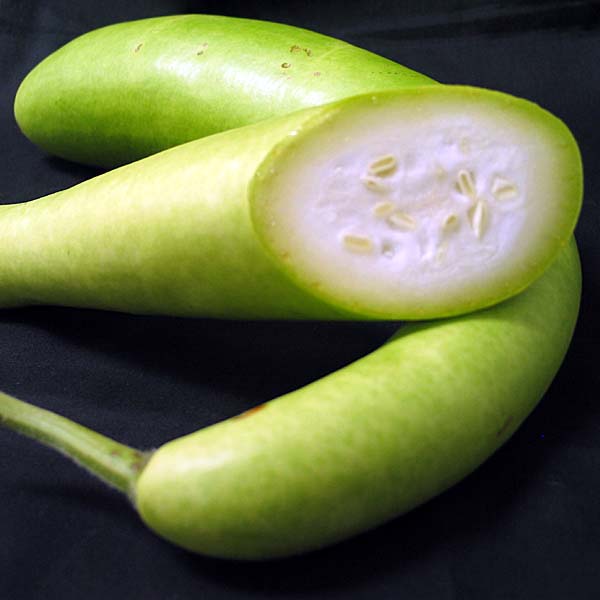
Vegetable Of The Week WINTER MELON / BOTTLE GOURD

Ayesha's Kitchen

Ayesha's Kitchen

The winter melon, also called white gourd or ash gourd, is a vine grown for its very large fruit, eaten as a vegetable. The fruit is fuzzy when young. By maturity, the fruit loses its hairs and develops a waxy coating, giving rise to the name wax gourd, and providing a long shelf life. The melon may grow as large as 1-2 metres in length. The word “melon” in the name is somewhat misleading, as the fruit is not sweet. Originally cultivated in Southeast Asia, the winter melon is now widely grown in East Asia and South Asia as well.

Winter melon is also a common name for members of the Inodorus cultivar group of the muskmelon (Cucumis melo L), more commonly known as casaba or honeydew melons.

Uses

In North India and Pakistan, the vegetable is used to prepare a candy called Petha. In South Indian cuisine it is used to make curries. Occasionally, it is used to produce a fruit drink which has a very distinctive taste. It is usually sweetened with caramelized sugar, which enhances the taste.

 The winter melon requires very warm weather to grow but can be kept through the winter much like winter squash. The winter melon can typically be stored for 12 months. The melons are used in stir fry or to make winter melon soup, which is often served in the scooped out melon, which has been intricately decorated by scraping off the waxy coating.

The shoots, tendrils, and leaves of the plant may also be eaten as greens.

Winter melon is a common name for the inodorus cultivar group of the muskmelon (Cucumis melo L), or one of its members alternatively known as casaba, honeydew, or Persian.

Vernacular Names

Assamese: komora

Bengali: চাল কুমড়া chal kumṛa (lit. “thatch pumpkin”)

Burmese: kyauk pha-yon thee

Chinese: 冬瓜 dōngguā (lit. “winter melon”)

English: ash gourd, (Chinese) winter melon, fuzzy melon, green pumpkin, wax gourd, white gourd

French: courge cireuse, courgette velue (lit. “hairy zucchini”)

Hindi: पेठा peṭhā, pethakaddu

Indonesian: beligo

Japanese: とうがん tōgan (冬瓜, lit. “winter melon”)

Kannada: boodagumbala

Korean: 동과 donggwa, 동아 donga (冬瓜, lit. “winter melon”)

Malay: kundur

Malayalam: കുമ്പളങ്ങ kumbalanga

Marathi: कोहळा kohḷa

Portuguese: abóbora d’água (lit. “water pumpkin”), comalenge

Sinhala:පුහුල් Puhul

Taiwanese: dangguev (冬瓜, lit. “winter melon”)

Tamil: neer poosanikai (நீர்பூசனி)

Tagalog: kundol

Telugu: booḍida gummadikaaya

Thai: ฟัก fak

Tulu: ಕರ್ಕು೦ಬುಡ karkumbuda

Urdu: پیٹھہ, peṭhā

Vietnamese: bí đao

Recipes:

There are some of the recipes For this vegetable in Ayesha’s Kitchen as listed below:

Kaddu(Pumkin) (My Grandma’s Secret Recipe) Loki Kii Sabzi

Fruit Of The Week PEACH

peach

The peach (Prunus persica) is known as a species of Prunus native to China that bears an edible juicy fruit also called a peach. It is a deciduous tree growing to 5–10 m tall, belonging to the subfamily Prunoideae of the family Rosaceae. It is classified with the almond in the subgenus Amygdalus within the genus Prunus, distinguished from the other subgenera by the corrugated seed shell.

The leaves are lanceolate, 7–15 cm long (3–6 in), 2–3 cm broad, pinnately veined. The flowers are produced in early spring before the leaves; they are solitary or paired, 2.5–3 cm diameter, pink, with five petals. The fruit has yellow or whitish flesh, a delicate aroma, and a skin that is either velvety (peaches) or smooth (nectarines) in different cultivars. The flesh is very delicate and easily bruised in some cultivars, but is fairly firm in some commercial varieties, especially when green. The single, large seed is red-brown, oval shaped, approximately 1.3–2 cm long, and is surrounded by a wood-like husk. Peaches, along with cherries, plums and apricots, are stone fruits (drupes). The tree is small, and up to 15 ft tall.

The scientific name persica, along with the word “peach” itself and its cognates in many European languages, derives from an early European belief that peaches were native to Persia (now Iran). The modern botanical consensus is that they originate in China, and were introduced to Persia and the Mediterranean region along the Silk Road before Christian times. Cultivated peaches are divided into clingstones and freestones, depending on whether the flesh sticks to the stone or not; both can have either white or yellow flesh. Peaches with white flesh typically are very sweet with little acidity, while yellow-fleshed peaches typically have an acidic tang coupled with sweetness, though this also varies greatly. Both colours often have some red on their skin. Low-acid white-fleshed peaches are the most popular kinds in China, Japan, and neighbouring Asian countries, while Europeans and North Americans have historically favoured the acidic, yellow-fleshed kinds.

Peaches In Asian Tradition

Peaches are known in China, Japan, Korea, Laos, and Vietnam not only as a popular fruit but for the many folktales and traditions associated with it. Momotaro, one of Japan’s most noble and semi-historical heroes, was born from within an enormous peach floating down a stream. Momotaro or “Peach Boy” went on to fight evil oni and face many adventures. Peach flowers are admired by the Japanese but not as much as the sakura (cherry).

In China, the peach was said to be consumed by the immortals due to its mystic virtue of conferring longevity on all who ate them. The divinity Yu Huang, also called the Jade Emperor, and his mother called Xi Wangmu also known as Queen Mother of the West, ensured the gods’ everlasting existence by feeding them the peaches of immortality. The immortals residing in the palace of Xi Wangmu were said to celebrate an extravagant banquet called the Pantao Hui or “The Feast of Peaches”. The immortals waited six thousand years before gathering for this magnificent feast; the peach tree put forth leaves once every thousand years and it required another three thousand years for the fruit to ripen. Ivory statues depicting Xi Wangmu’s attendants often held three peaches.

The peach often plays an important part in Chinese tradition and is symbolic of long life. One example is in the peach-gathering story of Zhang Daoling, who many say is the true founder of Taoism. Elder Zhang Guo, one of the Chinese Eight Immortals, is often depicted carrying a Peach of Immortality. The peach blossoms are highly prized in Chinese culture.

It was in an orchard of flowering peach trees that Liu Bei, Guan Yu, and Zhang Fei took an oath of brotherhood in the opening chapter of the classic Chinese novel Romance of the Three Kingdoms.

Due to its delicious taste and soft texture, in ancient China “peach” was also a slang word for “young bride”, and it has remained in many cultures as a way to define young women or a general state of goodness (as in English, with peach or peachy keen).

A Vietnamese mythic history states that, in the spring of the year 1789, after marching to Ngọc Hồi and then winning a great victory against invaders from the Qing Dynasty of China, the King Quang Trung ordered a messenger to gallop to Phú Xuân citadel (Huế nowadays) and deliver a flowering peach branch to the Princess Ngọc Hân. This took place on the 5th day of the first lunar month, 2 days before the predicted end of the battle. The branch of peach flowers that was sent from the North to the Center of Vietnam was not only a message of victory from the King to his wife, but also the start of a new spring of peace and happiness for all the Vietnamese people. In addition to that, since the land of Nhật Tân had freely given that very branch of peach flowers to the King, it became the loyal garden of his dynasty.

A peach tree is also the context in which Kim Trọng and Thuý Kiều fell in love in The Tale of Kieu. And in Vietnam, the blossoming peach flower is the signal of spring. Finally, peach bonsai trees are used as decoration during Vietnamese New Year — Tết in Northern Vietnam.

Nutrition And Health

A medium peach (75g), has 30 Cal, 7g of carbohydrate (6g sugars and 1g fiber), 1g of protein, 140mg of potassium, and 8% of the daily value (DV) for vitamin C.

As with many other members of the rose family, peach seeds contain cyanogenetic glycosides, including amygdalin (note the subgenus designation: Amygdalus). These substances are capable of decomposing into a sugar molecule and hydrogen cyanide gas. While peach seeds are not the most toxic within the rose family, that dubious honor going to the bitter almond, large doses of these chemicals from any source are hazardous to human health.

Recipes:

Peach recipe will be soon updated.

Vegetable Of The Week TURNIP

Brassica_rapa_turnip

The turnip or white turnip (Brassica rapa var. rapa) is a root vegetable commonly grown in temperate climates worldwide for its white, bulbous taproot. Small, tender varieties are grown for human consumption, while larger varieties are grown as feed for livestock.

Description

The most common type of turnip is mostly white-skinned apart from the upper 1–6 centimeters, which protrude above the ground and are purple, red, or greenish wherever sunlight has fallen. This above-ground part develops from stem tissue, but is fused with the root. The interior flesh is entirely white. The entire root is roughly conical, but can be occasionally tomato-shaped, about 5–20 centimetres in diameter, and lacks side roots. The taproot (the normal root below the swollen storage root) is thin and 10 centimetres or more in length; it is trimmed off before marketing. The leaves grow directly from the above-ground shoulder of the root, with little or no visible crown or neck (as found in rutabagas).

Turnip leaves are sometimes eaten as “turnip greens” (“turnip tops” in the UK), and they resemble mustard greens in flavor. Turnip greens are a common side dish in southeastern US cooking, primarily during late fall and winter. Smaller leaves are preferred; however, any bitter taste of larger leaves can be reduced by pouring off the water from initial boiling and replacing it with fresh water. Varieties specifically grown for the leaves resemble mustard greens more than those grown for the roots, with small or no storage roots. Varieties of B. rapa that have been developed only for use as leaves are called Chinese cabbage. Both leaves and root have a pungent flavor similar to raw cabbage or radishes that becomes mild after cooking.

Turnip roots weigh up to about 1 kilogram, although they can be harvested when smaller. Size is partly a function of variety and partly a function of the length of time that the turnip has grown. Most very small turnips (also called baby turnips) are specialty varieties. These are only available when freshly harvested and do not keep well. Most baby turnips can be eaten whole, including their leaves. Baby turnips come in yellow-, orange-, and red-fleshed varieties as well as white-fleshed. Their flavor is mild, so they can be eaten raw in salads like radishes.

Nutrition

The turnips root is high only in Vitamin C. The green leaves of the turnip top (“turnip greens”) are a good source of Vitamin A, folate, Vitamin C, Vitamin K and calcium. Turnip greens are high in lutein (8.4 mg / 100g).

Origin

The turnip was a well-established crop in Hellenistic and Roman times, which leads to the assumption that it was brought into cultivation earlier. But Zohary and Hopf note that “there are almost no archeological records available” to help determine its earlier history and domestication. Wild forms of the hot turnip and its relatives the mustards and radish are found over west Asia and Europe, suggesting that their domestication took place somewhere in that area. However Zohary and Hopf conclude, “Suggestions as to the origins of these plants are necessarily based on linguistic considerations.”

Human Use

Pliny the Elder writes that he considered the turnip one of the most important vegetables of his day, rating it “directly after cereals or at all events after the bean, since its utility surpasses that of any other plant.” Pliny praises it as a source of fodder for farm animals, and this vegetable is not particular about the type of soil it grows in and because it can be left in the ground until the next harvest, it “prevents the effects of famine” for humans.

In Turkey, particularly in the area near Adana, turnips are used to flavor şalgam, a juice made from purple carrots and spices served ice cold.

Macomber turnip historic markerThe Macomber turnip is featured in one of the very few historic markers for a vegetable, on Main Road in Westport, Massachusetts.

Turnip lanterns are an old tradition; see Jack o’ Lantern for their association with Halloween. Laurie Lee, in “The Edge of Day”, an autobiography of a childhood in the Cotswolds, mentions the Parochial Church Tea and Annual Entertainment, which took place around Twelfth night. “We…saw his red face lit like a hot turnip lamp as he crouched to stoke up the flames.”

Recipes:

Recipes For turnips will be updatd soon in Ayesha’s Kitchen, Hold on!

Fruit Of The Week Kiwi Fruit

Ayesha's Kitchen

Ayesha's Kitchen

The kiwifruit, often shortened to kiwi, is the edible berry of a cultivar group of the woody vine Actinidia deliciosa and hybrids between this and other species in the genus Actinidia. The Actinidia is native to South of China.

The most common cultivars of kiwifruit are oval, about the size of a large hen’s egg (5–8 cm / 2–3 in long and 4.5–5.5 cm / 1¾–2 in diameter). It has a fibrous, dull brown-green skin and bright green or golden flesh with rows of tiny, black, edible seeds. The fruit has a soft texture and a unique flavour, and today is a commercial crop in several countries, mainly in Italy, China, and New Zealand.

Also known as the Chinese Gooseberry, the fruit was renamed for export marketing reasons in the 1950s; briefly to melonette, and then by New Zealand exporters to kiwifruit. This latter name comes from the kiwi — a flightless bird and New Zealand’s national symbol, and also a colloquial name for the New Zealand people.

Names

This fruit had a long history before it was commercialised as kiwifruit and therefore had many other older names.

Kiwifruit was originally known by its Chinese name, yáng táo (Sunny Peach) or Mihou Tao (Macaque Peach). After it was introduced to New Zealand by evangelist Isabel Fraser, people in New Zealand thought it had a gooseberry flavour and began to call it the Chinese gooseberry, although it is not related to the Grossulariaceae (gooseberry) family.

New Zealand exported the fruit to the United States in the 1950s. Among the exporters was the prominent produce company Turners and Growers, who were calling the berries melonettes, because the name Chinese gooseberry had political connotations due to the Cold War, and to further distinguish it from real gooseberries, which are prone to a fungus called anthracnose. An American importer, Norman Sondag of San Francisco, complained that melonettes was as bad as Chinese gooseberry because melons and berries were both subject to high import tariffs, and instead asked for a short Maori name that quickly connoted New Zealand. In June 1959, during a meeting of Turners and Growers management in Auckland, Jack Turner suggested the name kiwifruit which was adopted and later became the industry-wide name. In the 1960s and 1970s, Frieda Caplan, founder of Los Angeles-based Frieda’s Finest (aka Frieda’s Inc./Frieda’s Specialty Produce) played a key role in popularizing kiwifruit in the United States, convincing supermarket produce managers to carry the odd-looking fruit.

Most New Zealand kiwifruits are now marketed under the brand-name label Zespri which is trademarked by a marketing company domiciled in New Zealand, ZESPRI International. The branding move also served to distinguish New Zealand kiwifruit from fruit produced by other countries who could cash in on the “Kiwi” name, as it was not trademarked.

Cultivars

Almost all kiwifruit in commerce belong to a few cultivars of Actinidia deliciosa: ‘Hayward’, ‘Chico’, and ‘Saanichton 12’. The fruit of these cultivars are practically indistinguishable from each other and match the description of a standard kiwifruit given at the head of this article.

Sliced Golden KiwifruitGold Kiwifruit or “Hinabelle”, with yellow flesh and a sweeter, less acidic flavour resembling a tropical fruit salad, is a new Cultivar Group produced by the New Zealand Crown Research Institute, HortResearch and marketed worldwide in increasing volumes. Some wild vines in India have yellow fruit but are small and not commercially viable. Seeds from these plants were imported to New Zealand in 1987 and the company took 11 years to develop the new fruit through cross-pollination and grafting with green kiwifruit vines. Gold Kiwifruit have a smooth, bronze skin, a pointed cap at one end and distinctive golden yellow flesh with a less tart and more tropical flavour than green kiwifruit. It has a higher market price than green kiwifruit. It is less hairy than the green cultivars, so can be eaten whole after rubbing off the thin, fluffy coat. While the skin of kiwifruit is often removed before serving, it is completely edible.

Nutrition

Kiwifruit is a rich source of vitamin C, 1.5 times the DRI scale in the US. Its potassium content by weight is slightly less than that of a banana. It also contains vitamins A and E. The skin is a good source of flavonoid antioxidants. The kiwifruit seed oil contains on average 62% alpha-linolenic acid, an omega-3 fatty acid. Usually a medium size kiwifruit contains about 46 calories, 0.3 g fats, 1 g proteins, 11 g carbohydrates, 75 mg vitamins and 2.6 g dietary fiber.

Kiwifruit is often reported to have mild laxative effects, due to the high level of dietary fiber.

Raw kiwifruit is also rich in the protein-dissolving enzyme actinidin, (in the same family of thiol proteases as papain), which is commercially useful as a meat tenderizer but can be an allergen for some individuals. Specifically, people allergic to latex, papayas or pineapples are likely to also be allergic to kiwifruit. The fruit also contains calcium oxalate crystals in the form of raphides. Reactions to these chemicals include sweating, tingling and sore mouth; swelling of the lips, tongue and face; rash; vomiting and abdominal pain; and, in the most severe cases, breathing difficulties, wheezing and collapse. The most common symptoms are unpleasant itching and soreness of the mouth, with the most common severe symptom being wheezing. Severe symptoms are most likely to occur in young children.

This enzyme makes raw kiwifruit unsuitable for use in desserts containing milk or any other dairy products which are not going to be served within hours, because it soon begins to digest milk proteins. This applies to gelatin-based desserts as well, as the actinidin will dissolve the collagen proteins in gelatin very quickly, either liquifying the dessert, or preventing it from solidifying. However, the U.S. Department of Agriculture suggests that cooking the fruit for a few minutes before adding it to the gelatin will overcome this effect. Sliced kiwifruit has long been regularly used as a garnish atop whipped cream on New Zealand’s national dessert, the pavlova.

Kiwifruit also serves as a natural blood thinner. A recent study performed at the University of Oslo in Norway reveals that—similar to popular mainstream aspirin therapy—consuming two to three kiwifruit daily for 28 days significantly thins the blood, reducing the risk of clots, and lowers fat in the blood that can cause blockages.

The kiwifruit skin is edible and contains high amounts of fiber. In a fully matured kiwifruit one study showed that this as much as tripled the fiber content of the fruit. In addition, as many of the vitamins are stored immediately under the skin, leaving the skin intact greatly increases the vitamin c consumed by eating a single piece of kiwifruit when compared to eating it peeled. As with all fruit, it is recommended that if eating the skin, the fruit be washed prior to consumption.

Kiwifruit is one of the best natural sources of lutein and zeaxanthin.

Recpes:

Number of recipes For kiwi Fruit can be Found in Ayesha’s Kitchen:
Vegetable Of The Week CABBAGE

cabbage

The cabbage is a popular cultivar of a the species Brassica oleracea Linne (Capitata Group) of the Family Brassicaceae (or Cruciferae), and is used as a leafy green vegetable. It is a herbaceous, biennial, dicotyledonous flowering plant distinguished by a short stem upon which is crowded a mass of leaves, usually green but in some varieties red or purplish, which while immature form a characteristic compact, globular cluster (cabbagehead).

The plant is also called head cabbage or heading cabbage, and in Scotland a bowkail, from its rounded shape. The Scots call its stalk a castock, and the English call its head a loaf[citation needed]. It is in the same genus as the turnip – Brassica rapa L.

Cabbage leaves often display a delicate, powdery, waxy coating called bloom. The sharp or bitter taste sometimes present in cabbage is due to glucosinolate(s). Cabbages are also a good source of Riboflavin.

History

The cultivated cabbage is derived from a leafy plant called the wild mustard plant, native to the Mediterranean region, where it is common along the seacoast. Also called sea cabbage and wild cabbage, it was known to the ancient Greeks and Romans; Cato the Elder praised this vegetable for its medicinal properties, declaring that “It is the cabbage which surpasses all other vegetables.”  The English name derives from the Normanno-Picard caboche (head), perhaps from boche (swelling, bump). Cabbage was developed by ongoing artificial selection for suppression of the internode length.

Uses

The only part of the plant that is normally eaten is the leafy head; more precisely, the spherical cluster of immature leaves, excluding the partially unfolded outer leaves. Cabbage is used in a variety of dishes for its naturally spicy flavor. The so-called ‘cabbage head’ is widely consumed raw, cooked, or preserved in a great variety of dishes.

Cooked

Cabbage is often added to soups or stews. Cabbage soup is popular in central Europe and eastern Europe, and cabbage is an ingredient in some kinds of borscht. Garbure (from Provençal garburo) is a thick soup of cabbage or other vegetables with bacon. Cabbage may be an ingredient in kugel, a baked pudding served as a side dish or dessert. Cabbage is also used in many popular dishes in India.

Boiling tenderizes the leaves and releases sugars, which leads to the characteristic “cabbage” aroma. Boiled cabbage has become stigmatized because of its strong cooking odor and the belief that it causes flatulence. Boiled cabbage as an accompaniment to meats and other dishes can be an excellent source of vitamins and dietary fiber. It is often prepared and served with boiled meat and other vegetables as part of a boiled dinner. Harold McGee has studied the development of unpleasant smells when cooking brassicas and reports that they develop with prolonged cooking. According to Corriher’s Compendium smell doubles when prolonging cooking from 5 to 7 minutes; for best results cabbage should be sliced thinly and cooked for 4 minutes.

Cabbage rolls, a type of dolma, are an East European and Middle Eastern delicacy. The leaves are softened by parboiling or by placing the whole head of cabbage in the freezer, and then stuffed with a mixture of chopped meat and/or rice. Stuffed cabbage is called holishkes in Yiddish. A vegetable stuffed with shredded cabbage and then pickled is called mango.

Bulgarian CabbageThe largest cabbage dish is made in Macedonian city of Prilep, with 80,191 sarmas (cabbage rolls).

Bubble and squeak consists of potatoes and cabbage or, especially formerly, potatoes, cabbage and meat fried together. Potatoes and cabbage or other greens boiled and mashed together make up a dish called colcannon, an Irish Gaelic word meaning white-headed cabbage, grounded in Old Irish terms for cabbage or kale (cāl), head (cend or cenn) and white (find). In the American South and Midland, corn dodgers were boiled as dumplings with cabbage and ham.

Fermented and Preserved

Cabbage is the basis for the German sauerkraut, Chinese suan cai and Korean kimchi. To pickle cabbage it is cut fine, placed in a jar, covered with a brine made of its own juice with salt, and left in a warm place for several weeks to ferment. Sauerkraut (colloquially referred to simply “kraut”) was historically prepared at home in large batches, as a way of storing food for the winter. The word comes from German sauer (sour) and kraut (plant or cabbage) (Old High German sūr and krūt). Cabbage can also be pickled in vinegar with various spices, alone or in combination with other vegetables. (Turnips can be cured in the same way.) Korean baechu kimchi is usually sliced thicker than its European counterpart, and the addition of onions, chillies, papaya, gin, minced garlic and ginger is common.

Medicinal Properties

Cabbage is an excellent source of Vitamin C. It also contains significant amounts of glutamine, an amino acid which has anti-inflammatory properties. Cabbage can also be included in dieting programs, as it is a negative calorie food.

It is a source of indole-3-carbinol, or I3C, a compound used as an adjuvent therapy for recurrent respiratory papillomatosis, a disease of the head and neck caused by human papillomavirus that causes growths in the airway that can lead to death.

In European folk medicine, cabbage leaves are used to treat acute inflammation. A paste of raw cabbage may be placed in a cabbage leaf and wrapped around the affected area to reduce discomfort. Some claim it is effective in relieving painfully engorged breasts in breastfeeding women.

Varieties

There are many varieties of cabbage based on shape and time of maturity. Cabbages grown late in autumn and in the beginning of winter are called coleworts; their leaves do not form a compact head. “Colewort” may also refer to a young cabbage. The word comes from Latin caulis (stalk of a plant, cabbage) and Old English wyrt (herb, plant, root). A drumhead cabbage has a rounded, flattened head. An oxheart cabbage has an oval or conical head. A pickling cabbage, such as the red-leafed cabbage, is especially suitable for pickling; krautman is the most common variety for commercial production of sauerkraut. Red cabbage is a small, round-headed type with dark red leaves. Savoy cabbage has a round, compact head with crinkled and curled leaves. Winter cabbage will survive the winter in the open in mild regions such as the southern United States; the name is also used for Savoy cabbage.

Recipes:

Here in Ayesha’s Kitchen you can Find number of recipes For cabbage:

Pesto Chicken

Pesto Chicken is a very tasty and easy-to-make chicken and it is ideal For weight watchers + patients. A perfect dinner For cold winter nights …

Ingredients:

  • 1 chicken size 16 skinless
  • ¼ cup vinegar

FOR PESTO

  • ¼ cup olive oil
  • 2 big cloves of garlic
  • 4 green chillies
  • Some salt
  • Some Chinese salt
  • Some black pepper
  • 4 tbspns yogurt

VEGETABLES

  • 2 medium sized potatoes
  • 8 French beans / green beans
  • 2 mushrooms
  • 4 heads of broccoli
  • ½ cup peas
  • 1 carrot

Procedure:

-Wash chicken thoroughly and apply some vinegar on it. Keep aside For some time, minimum 4 hours and then wash again.

-Pat with a clean kitchen towel. Make some deep cuts in breasts and legs.

-In a blender, put all the ingredients of pesto and blend. Now apply this on chicken with your hands. Use your Fingers to apply in cuts.

-Refrigerate over a night.

-Wash and peel potatoes and carrots, trim off the ends of green beans, slice mushrooms and other vegetables.

-In a baking tray, place whole chicken and vegetables and pour the marinade all over. Bake in a preheated oven For an hour or more at 220 degrees Celsius.

-Hot sizzling chicken is ready to be served.

Outcome:

Tasty and different pesto Chicken is ready to be served.

DSC02017

Tips:

-Apply nicely.

Servings:

This will serve 6 persons.